The Inner Mountain
Symbols of the pilgrim’s journey home
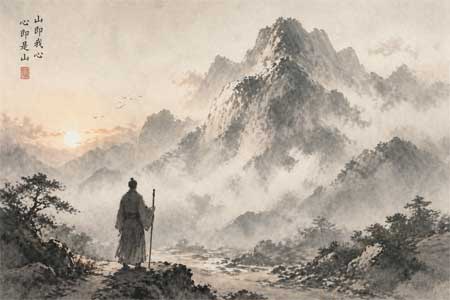
The pilgrim walks with a staff, climbs a mountain, seeks a temple, and drinks from the river. But in the final stage of the journey, described in Return Home, these external objects reveal their true nature. They are not just things in the world; they are maps of the soul.
The mountain as spirit
To climb a mountain is to face our own limitations. The steep paths are our doubts; the rocky outcrops, our fears. But as we ascend, we shed the weight of our ego. We realize that the summit is not a place to conquer, but a perspective to gain. From the top, we see that the path was never linear, but a spiral returning to the center.
The temple as refuge
The temple is often seen as a building, but in Ch’an, it is the body itself. It is the sacred space where mind and heart meet. To "enter the temple" is to enter into presence, to bow before the mystery of life. It is the realization that we carry the sacred within us, wherever we go.
The staff as support
The pilgrim’s staff is more than a walking stick. It is the support we find in tradition, in teachers, and in our own practice. But ultimately, the staff reminds us that we must walk our own path. It touches the ground with every step, grounding us in reality, keeping us upright when the winds of doubt blow.
In this final reflection, we understand that the pilgrimage was never about going somewhere else. It was about waking up to where we are. The disciple becomes the master not by learning new secrets, but by realizing that the secret was always there, hidden in plain sight, in the simple act of being alive.
Continue the Journey
This article is an excerpt from Return Home. If these words resonated with you, the full book offers a deeper map for your inner pilgrimage.
Get the Book on Amazon →