Root and Soil
The silent dialogue between Indian Dharma and Chinese Taoism
Bodhidharma arrived in China carrying a seed. It was the seed of Indian Buddhism: rigorous, analytical, focused on the emptiness of all phenomena. But when he looked at the Chinese people, he saw a different spirit. They were pragmatic, connected to nature, and deeply influenced by Taoism and Confucianism.
The story of Shaolin is the story of what happened when that seed fell into that soil. It did not remain purely Indian. It did not remain purely Chinese. It became something new: Ch'an.
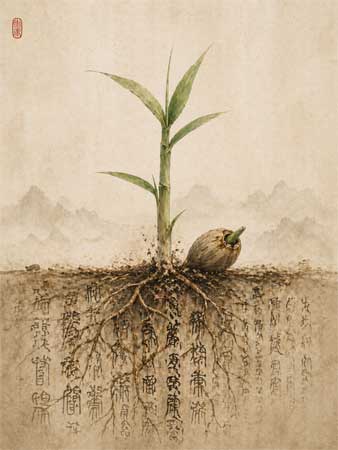
The meeting of two worlds
Indian Buddhism spoke of Sunyata (emptiness). Taoism spoke of Wu (the void that contains all potential). At first glance, they seemed similar. But the Indian approach was often one of negation—denying the self to find the truth. The Chinese approach was one of affirmation—finding the truth in the flow of nature.
Ch’an Buddhism bridged this gap. It took the meditative depth of India and combined it with the natural spontaneity of China. The result was a practice that was less about studying texts and more about direct experience. It was a Buddhism that could be found in a cup of tea, in a brushstroke, or in a martial arts form.
From zazen to Kung Fu
This synthesis explains why Shaolin is unique. In other Buddhist traditions, the body is often seen as an obstacle to be transcended. In Shaolin, influenced by Taoist health practices, the body is a vessel for the Tao. Movement becomes meditation. Strength becomes compassion.
The monks of Shaolin did not practice martial arts to fight. They practiced to harmonize their internal energy (Qi) with their external actions. They understood that a calm mind requires a healthy body, and a healthy body requires a calm mind. This holistic view is the legacy of the "Root and Soil" meeting.
The living ember
Today, Ch’an has spread to the West, becoming Zen in Japan and Vipassana in Europe. But its roots remain in that initial fusion. Understanding this history helps us appreciate that spirituality is not static. It adapts. It flows. It changes form while keeping its essence.
The Heart of the Temple invites you to trace this history not as an academic exercise, but as a way to understand your own practice. Whatever your background, whatever your "soil," the Dharma can take root there. It asks only for your attention, your sincerity, and your willingness to grow.