Bodhidharma’s Wall
The Origin of Ch’an in Shaolin
Where the desert wind whirls in spirals of silence and dust, a man was born destined to alter the course of the human spirit. His name was Bodhidharma, though in China he came to be known as Da Mo. His figure resonates between history and myth, between what can be spoken and what can only be contemplated in silence. Yet his legacy needs no defense: even today, it reverberates in every step of a monk walking toward the temple.
The journey to China
Between 520 and 527 CE, Bodhidharma crossed the seas to northern China. The land he found was a fragmented empire, trying to stitch its wounds with the veneer of ritual Buddhism. There, Emperor Wu of the Liang dynasty, a great protector of the Dharma, received him with curiosity and pride.
The conversation between them was recorded for posterity:
“No merit,” replied Bodhidharma, plainly.
The emperor, perplexed, responded: “Then what is the essence of the sacred teachings?”
“A vast emptiness, with nothing sacred,” said Da Mo.
“And who are you, that you speak thus?”
“I do not know,” replied Bodhidharma, and he departed.
When the emperor realized, too late, who had stood before him, he sent emissaries to bring him back. But it was too late. The monk had vanished into the mist.
The Cave, the Wall, and the Silence
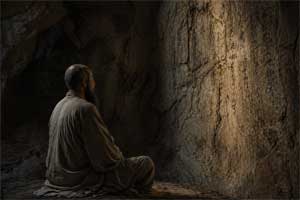
Da Mo’s journey led him to the Shaolin Monastery, in the Songshan mountains. But he did not enter to teach immediately. He retreated to a cave that can still be visited today, and there he sat for nine years, facing a wall.
He did not meditate for the sake of stillness, but out of compassion. He practiced piguan (wall-gazing). The wall was not stone, but the ego. It was his way of dismantling the mind, layer by layer, until only the true nature remained.
Hui Ke and the transmission of the heart
A monk named Shenguang wished to learn from him. Day after day, he asked for teachings, but Da Mo remained silent. The young man, determined to prove his sincerity, cut off his arm and offered it as proof of his resolve.
Da Mo finally spoke:
“I want you to pacify my mind,” the young man replied.
“Bring it here and I will pacify it,” said the master.
“I have searched for it and cannot find it.”
“Then it is pacified,” replied Bodhidharma.
That young man became Huì Kě, the second patriarch of Ch’an. Not because he knew more, but because he had emptied himself. With Bodhidharma, Buddhism in China changed. It ceased to be only sutras and ceremonies, and became a direct path to the mind. Ch’an is not a doctrine: it is a way of being, breathing, and observing without seeking.
His presence marked a before and after. The body became a temple. Silence, word. The wall, a mirror. And from then on, whenever a monk joins his palms before his chest and sits in lotus without expecting anything, Bodhidharma breathes with him.