Daughters of the Dragon
The invisible legacy of Shaolin women
In the official chronicles of Shaolin, written mostly in masculine ink, female figures appear little, if at all. The scrolls speak of patriarchs, warrior monks, and lineages transmitted from master to male disciple. Yet, in the margins of silence, in the interstices of the written account, dwells the quiet memory of many women who also walked the path of the Dharma.
They were not merely cooks or cleaners serving the temple. They were masters, healers, warriors of the spirit, and guardians of a wisdom that did not need to shout to be heard. Their legacy is not found on stone steles, but in the quality of the practices that survived, in the gentle gestures that precede every form, and in the economy of movement that defines true Shaolin art.
The Yong Tai convent: Tranquility enduring
Nestled on the lower slopes of Mount Song, far from the central compound of Shaolin, lies the convent of Yong Tai. It was not built to be seen, but to be felt. Its presence is not announced by strident bells, but by the whisper of water and the muted sound of steps on the earth.
Yong Tai was not born as a refuge of passive cloister, but as a space of active formation. A place where women could learn meditation, martial art, healing, and care, integrating body, mind, and spirit without submitting to the strict canons of the male temple.
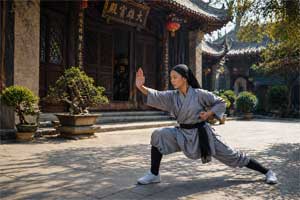
It is said that the founder of this space was a woman known as Mother Zhiyuan. Before consecrating herself to monastic life, she was a disciple of a martial arts and Ch’an master. She sought no fame, only a space to teach other women to unite body and spirit. With her own hands, she helped build the first walls of the monastery, using bamboo trunks and river clay.
Beyond names: Masters of the Dharma
The history of Shaolin would not be complete without figures like Zhengdao, Miaozong, Zongchi, or Zhi Wei. Women whose names barely appear in canonical texts, but whose step still resonates in the bodily memory of those who received them.
Zhengdao, for example, was known for her teaching without words. She did not speak of complex doctrines. She offered tea, looked into the eyes, and said: “If the world is at war, begin peace in the way you serve the rice.” For her, the Dharma was not outside, but in the hands, in the posture, in how you chose to move while the world trembled.
Miaozong, on the other hand, was a master who could bring down a man with a single touch, but who preferred to stop a fight simply by entering the room with her head bowed and her breath calm. When young monks arrived with arrogance to test their strength, she would only raise a hand and ask: “Are you going to fight me... or are you going to fight your own impatience?” That phrase was enough to disarm not only the body, but the ego.
The body as temple, not as weapon
Unlike the masculine ideal, often focused on external domination and resistance, many women in Shaolin found more internal paths. They understood the body not as a battlefield, but as a walking temple. It was not about dominating it, but listening to it.
Their martial practice was different: less aggressive, but no less intense. They worked with the pulse, with breathing, with the economy of movement. They used weapons like the fine chain, the short staff, or the iron fan, not to knock down, but to neutralize. Not to hurt, but to stop. Their victory was not over the other, but over fear.
Furthermore, they were guardians of a medical legacy deeply rooted in tradition. They mastered the use of herbs, acupuncture, and Tuina massage with an almost intuitive skill. It was said that an experienced nun could diagnose a person's emotional state simply by touching their wrist. For them, healing the body meant healing the mind, and healing the mind was opening the heart to emptiness.
They did not need names carved in marble. They left their mark in the silent corridors, in the way a novice learned to breathe before acting, and in how a wound was healed with firm hands and an open heart. They were the invisible roots that held the Shaolin tree.