Sweeping the courtyard
Finding the Tao in the simplicity of daily routine
We often imagine enlightenment as a lightning bolt, a sudden revelation on a mountaintop, or a profound state achieved after hours of seated meditation. But in the temples of Shaolin, the masters teach a different truth: the deepest practice happens when we descend from the mountain and enter the kitchen.
In The Heart of the Temple, we explore the concept that "in routine dwells the Tao." This is not a metaphor. It is a practical method for awakening.
The meditation of action
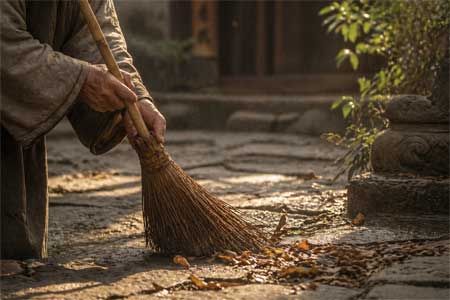
For a monk, sweeping the courtyard is not a chore to be finished quickly so they can return to "important" things. Sweeping is the important thing. Each movement of the broom is an act of cleaning the mind. Each leaf removed is an attachment let go. The rhythm of the work synchronizes with the breath, turning labor into a moving meditation.
This approach transforms the mundane into the sacred. There is no separation between the training hall and the dining hall. The mindfulness cultivated in Zazen (seated meditation) is tested and deepened in the act of peeling potatoes or washing robes.
Cooking as an offering
In the temple kitchen, food is prepared with a reverence usually reserved for religious rituals. The cook knows that the meal is fuel for the practice of dozens of beings. To cook with distraction or anger is to poison the community. To cook with love and presence is to offer medicine.
This attention to detail extends to every aspect of life. How we put on our shoes, how we greet a brother, how we sit. These small acts are the bricks with which the temple of character is built.
The discipline of freedom
Modern society often views routine as a prison. We seek constant novelty, believing that freedom lies in escape. But the Shaolin tradition teaches that true freedom is found within structure. By fully inhabiting our routines, we stop fighting against the present moment. We stop wishing we were somewhere else.
When we accept the task at hand with total commitment, the ego dissolves. There is no "I" who is bored or tired. There is only the sweeping. Only the cooking. Only the living.
This volume invites you to look at your own daily life not as an obstacle to your spiritual path, but as the path itself. Your home is your temple. Your work is your practice. And your life, in its beautiful simplicity, is the Dharma.