Embracing the Tiger
When fear stops being an enemy
There are fears that have names. Fears of the dark, of failure, of loneliness. But there is an older fear, one that needs no words or defined shapes. It lives beneath the chest, in that place where explanations do not reach. It does not scream, it does not threaten. It simply waits. Silent. Like a tiger.
In our culture, we have been taught to fight what scares us or to flee from it. They tell us that the brave person is one who does not fear, or who overcomes their fear. But the wisdom of the temple, the kind Liang discovers in the bamboo grove, offers us a third path, much more radical and liberating: if you flee, it pursues you. If you fight, it devours you. If you look at it, it shows you who you are.
The shadow that lurks
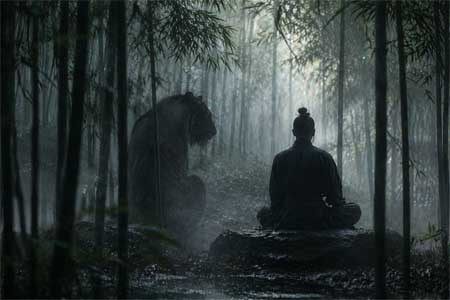
When Liang ventures into the forest, he is not looking for the tiger. The tiger appears because it is time. In the narrative of Empty Bowl or Full Bowl, this encounter is not accidental. It represents the moment when the practitioner stops looking outward—toward techniques, rituals, approvals—and turns toward their own interiority.
That shadow tiger is not an evil beast. It is the sum of everything we have hidden to survive: our contained rage, our denied vulnerability, our crudest instincts. As long as we ignore it, the tiger lurks. Our vital energy is spent keeping it at bay, building invisible cages of "should" and "should not."
But the day Liang sits before it, something extraordinary happens. He does not draw a sword. He does not close his eyes. He asks: "What do you want from me?". And the tiger's answer was clear: "To see if you still flee."
The hour of the tiger and the breath
Integrating the shadow is not an intellectual act. It is visceral. In the chapter "The Hour of the Tiger and the Breath," Liang learns that this communion is not achieved by thinking, but by breathing. Master Ming guides him to stop controlling his breath and start inhabiting it.
When breathing becomes deep and authentic, the body stops pretending. The social armor falls away. And in that naked space, the tiger ceases to be a threat to become a source of power. It is no longer the beast that wants to devour us, but the pure vitality that wants to flow through us.
This is what we call "the hour of the tiger": that sacred instant when body and spirit cease to be separate. Where fear transmutes into presence. Where we understand that true strength is not that which imposes, but that which sustains.
Stop stalking yourself
How much energy do we spend every day avoiding feeling what we feel? How much effort do we dedicate to appearing calm when there is a storm inside? The inner tiger lurks because it feels we give it no space. When we offer that space, when we say "you are here, I see you, you are part of me," the tension dissolves.
Embracing the tiger means accepting our capacity to be fierce, yes, but also our capacity to be tender. It means recognizing that sensitivity is not weakness, and that firmness is not hardness. It is integrating opposites to stop being split.
Liang leaves the clearing different. Not because he has defeated anyone, but because he has stopped being at war with himself. His steps cease to be light due to lack of weight, and begin to be firm because they have roots.
Invitation to the gaze
Today we invite you to stop for a moment. Close your eyes and ask yourself: What am I avoiding looking at? What emotion or what part of myself do I keep locked in the basement for fear it will come out?
Do not try to change it. Do not try to expel it. Just invite it to sit with you. Observe its shape, its temperature, its breath. You will see that, when seen with compassion, the beast transforms. It stops roaring to start accompanying you. Because in the end, the tiger is not your executioner. It is your guardian.
Inspired by the teachings of
"Empty Bowl or Full Bowl"
by Margarita Busqui and Shifu Cruz.