Sweeping Without Haste
The hidden meditation in small tasks
We live obsessed with the extraordinary. We seek enlightenment on mountain peaks, in silent retreats, or in great moments of revelation. However, true mastery rarely occurs under the spotlight, but in the shadows of the everyday. It happens when no one is watching. It happens, for example, while we hold a broom.
In the temple, chores are not punishments nor simple logistical obligations. They are the hardest training ground for the mind. Because it is easy to meditate sitting in silence for ten minutes. It is infinitely more difficult to maintain presence while picking up dust that we know will fall again tomorrow.
The broom as a mirror
When Liang arrives at the monastery, he dreams of martial arts, of precise strikes and acrobatic jumps. What he receives, instead, is a broom made of dry, rough, old branches. At first, he takes it with resignation. His mind runs forward, imagining glorious futures, while his hands perform a mechanical movement backward.
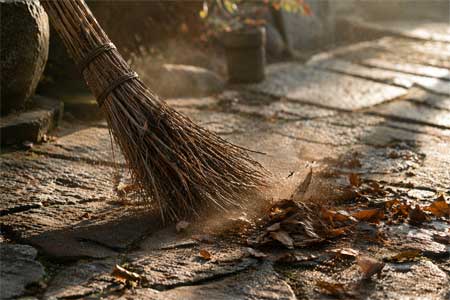
But Master Ming, with that wisdom that needs no shouting, stops him. "You are leaving the dust, not removing it," he says. And he is not referring to physical cleaning. He refers to intention. If the mind wanders, the dust remains. The broom then becomes a relentless mirror: it returns to us exactly the state of our consciousness. If we are anxious, we will sweep brusquely, raising blind clouds. If we are bored, our movements will be clumsy and slow. Only when we are present does the broom dance.
Sweeping the world, not just the courtyard
There is a revealing moment when Liang finds, among the leaves in the courtyard, a small paper crane with a message: "The world is not swept. It is contemplated." This phrase changes the perspective. To stop seeing dirt as an enemy to be eliminated and start seeing it as part of the natural cycle of things.
Sweeping, in this profound sense, is an act of acceptance. We do not try to change the courtyard by force; we accompany it in its transformation. Each falling leaf is a reminder of impermanence. Each grain of dust we remove is a metaphor for our own intrusive thoughts. We do not fight them, we do not judge them. We simply observe them pass and let them go, gently, without attachment.
Brother Hui, another of Liang's guides, teaches him that "what you call dust, is also you." This radical identification with the task dissolves the boundary between the doer and the deed. There is no longer a "self" sweeping a "floor." There is only sweeping. Only pure presence acting in the now.
The dignity of the invisible
In our society, we value the visible: the promotion, the like, the applause. The temple invites us to value the invisible: the harmony of the gesture, the integrity of silent effort. Sweeping without haste is an act of rebellion against the culture of immediacy. It affirms that this instant, however small and repetitive it may seem, has as much value as any other.
Master Ming confesses to having broken a broom in his youth out of anger, believing he deserved more "noble" tasks. His master replied: "Until you stop feeling that this is little, you will not be ready for what is much." That humility is the door. When we stop despising the small, the entire universe fits in our hands.
Invitation to presence
Today, we invite you to choose one of those tasks you usually do on "autopilot": washing dishes, making the bed, sweeping the terrace. Stop for a second before starting. Feel the weight of the object in your hands. Observe the water, the fabric, the broom. And do it slowly. So slowly that you can notice every muscle working, every breath pacing the movement.
You will see how, suddenly, the task stops being a burden and becomes a refuge. Because in the end, it is not about cleaning the external world. It is about clearing the interior so that, finally, we can see what has always been there.
Inspired by the teachings of
"Empty Bowl or Full Bowl"
by Margarita Busqui and Shifu Cruz.